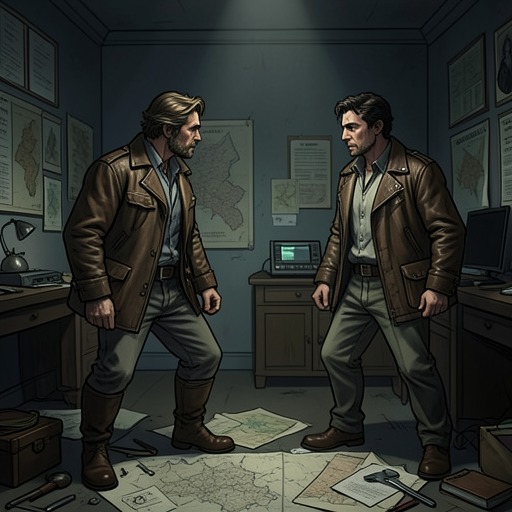
Reggie
The Legend of William OhReggie is introduced as the Tank, a large young climber whose conspicuous size and heavy armor make him look cumbersome until danger demands exactly the kind of force and endurance he possesses. He becomes valuable not because he offers abstract authority or elaborate strategy, but because he turns physical strength into immediate protection, rescue, and practical cooperation. His importance lies in that contrast: the apparently slow, oversized fighter repeatedly becomes the person who gets others moving when hesitation would be fatal.
Identity and Introduction
Reggie first appears during the group’s return through the cave system, when a rather large and sweaty young man climbs down Loth’s rope and barely fits on the ledge. Will recognizes him from the gathering outside the cave system as “The Tank,” an archetypal label that initially reduces him to his build, armor, and defensive role. Reggie then gives the label a personal center by introducing himself plainly as Reggie and offering his hand. The scene establishes both sides of his characterization: he is physically overwhelming, yet socially direct and approachable.
His apparent bulk also produces an early misreading. He looks exhausted and encumbered, and his oversized armor makes the ledge and tunnel seem even more restrictive. Later, however, Reggie explains that the condition seen during the previous quest was not his normal level of fitness: he is two levels higher and is not wearing a hundred pounds of steel. The clarification separates the person from the visible equipment. The Tank is not merely a slow wall of armor; the armor is a role and a burden that conceal a more capable fighter beneath them.
Strength Under Pressure
Reggie’s defining contribution emerges during the retreat through the cave system. When Mason prepares to climb the rope hand over hand, Reggie refuses to let the group lose time. He apologizes, grabs the Nuker, and throws him over his shoulder, drawing an indignant shriek from the noble but removing the immediate obstacle. He then hauls Mason upward and into the hole with the rough efficiency of a dockworker handling a sack of flour. The action is undignified, but its purpose is unmistakable: Reggie values movement and survival over ceremony.
His assistance is not a single burst of strength. When Mason slows again, Reggie calls for him to keep moving and warns that there is movement behind him. When Mason wants to take over, Reggie insists that it is his turn and retrieves the tower shield he had left beside the tunnel. The shield makes his function literal: he is both the carrier who gets people out and the defensive presence who buys them time. His words and actions create momentum when the retreat threatens to collapse into delay.
Once aboveground, the cost of that effort becomes visible. Reggie is well and truly spent and slumps down as soon as he reaches safety. Even so, when the others begin sprinting toward camp with weapons and Abilities ready, he forces himself to his feet and follows, though his armor burdens him. His exhaustion does not erase his reliability; it defines its price. Reggie’s strength is not effortless invulnerability but a willingness to spend his body until the immediate danger has passed.
Loyalty, Contracts, and Party Politics
Reggie’s relationship with William Oh develops through practical trust. After the group’s success, Reggie asks how William did, and William reports an exceptional result while noting that Loth won the MVP. Reggie’s friendly exchange places him within the social rhythm of the climbers rather than outside it as a silent hired weapon. When William explains that the group is heading to a smith, Leon’s General Store, and the bazaar, he asks Reggie to remain nearby and look menacing until they have spent enough cash not to appear an easy meal.
Reggie accepts immediately. He laughs, agrees to provide the threatening presence William needs, and explains that William saved his life and that his own plans for the night are not very different. The arrangement is comic on the surface, but it also records a reciprocal debt. Reggie is not simply recruited through abstract friendship; his willingness to help is grounded in a concrete rescue and in the shared practical problem of surviving with newly acquired money in a vulnerable town.
William then asks Reggie to join his Party, but Reggie cannot accept because he is under contract to bodyguard Mason Lanover until Mason reaches level 30, or until he has worked for Mason’s father for ten years after the father’s death. The obligation places a hard boundary around Reggie’s loyalty. He is willing to assist William, travel with him temporarily, and protect him in a limited circumstance, but the larger structure of his life is governed by a contract.
Reggie leaves open a conditional future. William can ask again if he is still alive after Mason reaches level thirty; alternatively, if William somehow persuades Mason to join his Party, Reggie would be contractually required to come along. Yet Reggie also recognizes the political obstacle: Mason’s father would be furious if his son entered another Party. Mason is technically free to choose, but Reggie observes that on paper he is free, which is all his father cares about. Through Reggie, the narrative exposes the difference between formal status and practical control. His bodyguard contract protects Mason while simultaneously limiting Reggie’s own mobility, and Mason’s nominal autonomy is weakened by family power.
A Recurring Ally in Dangerous Crossings
Reggie reappears during later hazardous movement through the cavern systems, where his assistance remains connected to Mason and to the group’s collective survival. After the group’s ordeal, Reggie rises above the others to thank Mason, his voice carrying over the surrounding noise. He had not been the person who folded under pressure, but he treats one person’s problem as everyone’s problem. That response reinforces his communal ethic: endurance is not used to claim superiority over weaker companions, but to keep the group from abandoning one of its members.
A minute later, Reggie gives Mason a hand back onto the stone side of the cavern system. Loth has created a rope bridge between the openings, linking the Yeti Ice Cave to the Kaith tunnels, and the group uses the firmer stone footing to haul people in. Reggie’s role here is less spectacular than throwing someone over his shoulder, but it is structurally similar. He supplies the physical assistance that turns an improvised route into a usable escape and helps Mason cross the boundary between danger and safety.
His continued presence also shows that his loyalty is not limited to the first rescue. When he later sees William equipped with the tomahawk, Reggie quietly points him out to Mason and identifies him by the weapon. The gesture suggests that William’s reputation and recognizable combat identity have become part of the group’s shared awareness. Reggie notices the transformation without claiming credit for it, remaining an observer and ally within the expanding network of climbers.
Character Function and Significance
Reggie functions as an ally whose characterization is built through action rather than exposition. His first label, the Tank, makes him seem like a fixed combat type, but the surrounding scenes complicate that impression. He is strong enough to carry the Nuker and haul Mason upward, disciplined enough to retrieve his tower shield, durable enough to continue after collapsing from exhaustion, and socially flexible enough to guard William’s money-spending expedition. His apparently simple role becomes a dependable form of intelligence: when a situation demands speed, weight, or protection, Reggie understands what must be done before anyone has time to formalize a plan.
At the same time, the book does not turn him into an unbound heroic protector. His contract to Mason governs whom he can officially serve, while his own comments reveal how family authority and written obligations shape Party membership. Reggie therefore embodies a recurring tension in the setting between personal loyalty and institutional rules. He can repay William for saving his life, but he cannot simply convert gratitude into a new permanent allegiance. His usefulness is immense, yet it remains negotiated through contracts, levels, family expectations, and the material demands of armor.
The result is a character whose narrative value comes from the meeting of reliability and constraint. Reggie repeatedly makes survival possible at the moment of physical crisis, but the story also shows that even a person powerful enough to carry others out of a cavern may not be free to choose his own Party. The Tank is thus both a rescue mechanism and a person caught inside the system he helps others navigate: a conspicuous wall of strength whose most revealing feature is not that he can bear weight, but that his own commitments determine where he is allowed to stand.